

Stop Posting Notes. Unlock Your Notes Performance With Positioning Statements.
This is an update of the first post I ever wrote about Notes that went viral. Here's the June 2026 update...

I’ve been serious about Substack for almost a year now, and the whole time I’ve been studying Notes that get real traction. And believe it or not, it’s not just from the biggest accounts. Actually funny enough, those aren’t even the ones with the best Notes.
I’ve found some real gems out there, and as I’ve studied and honed my own skills, I’ve become a little bit “known” in my little corner of Substack on the topic of Notes. 😃
What I’ve seen is that with the Notes that land hardest, there’s always a pattern.
The pattern is that they’re usually positioning statements.
They draw a line in the sand: here’s what I believe, here’s what I’m rejecting.
Whether it’s through a story, a quote tile, or a short or medium sized Note, that’s what they’re doing.
And they’re also a filter.
The filtering happens when the right reader see themself in it.
Everyone else scrolls past — and that’s exactly what you want to happen.
But here’s what I didn’t know when I first wrote this post: the formulas that work best for you depends on who you are as a creator.
I’ve spent the last several months developing what I call The Substack Creator Types… you can find out what type you are here:
Once you know your type, the right formulas stop feeling like a guessing game.
Each type has natural Notes that land for them, and other Notes that feel forced. Finding out what ones work with your type is the real unlock here, and you’re going to be blown away when you experience it.
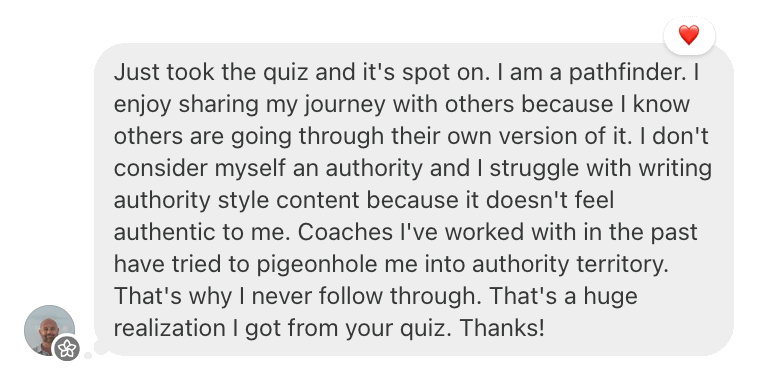
So here are the 5 Note Types — with notes on which type each one fits best, and how to use them differently depending on where you are in your journey.
1. The Reframe
This is the myth-buster. You take something people in your niche treat as gospel and flip it to reveal a deeper truth underneath.
The trick is finding the thing everyone thinks they already know. The “obvious” best practice. The advice repeated so often nobody questions it anymore. Then you show them what’s actually true underneath the assumption.
Best for Authority types. Reframes work because the writer is willing to say I see something here that the rest of you are missing. That’s an Authority move at its core, and it lands hardest when you have some receipts behind it.
If you’re new: go gentle. A reframe from someone with two posts to their name can read as posturing. Anchor it in something you’ve genuinely experienced rather than something you’ve theorized about.
If you’ve been at this a while: plant your flag harder. You’ve earned the right.
(And it doesn’t have to be some gross ChatGPT “it’s not X it’s Y shit. You’re obviously not going to copy-paste that and expect it to land in 2026. But comparisons existed long before ChatGPT entered the room. You can still compare things and make them your own. 😂)
2. The Arrival Story
“I used to think… then I realized…”
This is your evolution on display. Past struggle, false belief you held, moment of insight, where you stand now.
What makes it powerful is the admission that you once thought the wrong thing — that you bought into the same stuff your readers are currently stuck in. You’re not talking down to anyone. You’re saying, I was exactly where you are.
Best for Pathfinder types. This is literally the Pathfinder’s home turf — the whole archetype is built around “I went through it, and here’s the map back.” When a Pathfinder writes an arrival story, it doesn’t feel like a humble-brag. It feels like a hand extended backward.
If you’re new: this is honestly your fastest path to traction. You don’t need authority to write an arrival story. You just need to be honest about what changed and why.
3. The Observation
“The [people who already have what you want] don’t…”
This one is sneaky-effective. Instead of giving advice directly, you point to people either already living the result your readers want, or point to the thing people keep creating as real when it’s just not.
For example, your readers have probably been told success requires a bunch of different things. People are constantly keeping the narrative alive, too. 🙄 (literally just saw someone post that they “accidentally” created a $6K/mo. recurring revenue stream. Reallly? Come on. Stop it.)
So use other examples out there instead of your own to make it resonate faster (because most likely they’ve seen it, too.)
Best for Magnetizer types. Magnetizers attract through resonance and noticing. The Observation Note is essentially “I see something — do you see it too?” and when a Magnetizer writes one, the right people feel pulled in without quite knowing why.
If you’re new: this is also a great starter format, because you’re not claiming expertise. You’re pointing at a pattern. Anyone can do that credibly.
If you’ve been at this a while: the observations get sharper because you’ve watched more cycles. Use that.
4. The Versus
“Old way vs. my way.”
This one draws a clear line. Name the dominant approach in your space — the thing everyone teaches, the “industry standard,” the advice that sounds smart but quietly burns people out. Show its flaw without ranting. Reveal the cost nobody talks about.
Then offer your alternative frame. Present it as your way rather than the right way. The thing you’ve chosen instead, and the reason why.
Best for Authority types, with a Pathfinder assist. Authority gives it the spine, but Pathfinder energy keeps it from tipping into “I’m right, they’re wrong.” The blend is what makes it land.
If you’re new: be careful here. A Versus Note from a newer creator can read as picking a fight to get noticed. Make sure your “versus” comes from something you’ve genuinely experienced as broken — because other people have likely seen it too, so it’ll resonate more.
If you’ve been at this a while: this is one of your sharpest tools. You’ve watched the old way fail enough people that you can write about it with quiet certainty.
5. The World-Is-Shifting Declaration
“Here’s what’s changing — and here’s what it means for you.”
This is the big-picture Note. You zoom out from tactics and name a macro trend: something happening in the culture, the economy, the platforms, the way people buy or connect or work right now. Then you bring it back down to earth.
Best for Authority types, but Magnetizers can do a softer version. When an Authority writes this Note, it’s pattern recognition. When a Magnetizer writes it, it’s “I’m sensing something — are you sensing it too?” Both work. Pathfinders tend to struggle here unless they tie the shift directly to their own journey.
The best ones reframe disruption as opportunity. Less “everything is falling apart” doom-spiral, more “everything is reorganizing, and here’s where the advantage is now.”
Why these work
None of these formulas are directly teaching in Notes, they’re doing the connecting work. That’s what Notes are for.
They say here’s how I see the world — and let the right people self-select. That’s what builds an audience that actually buys eventually. Resonance does the work that pitching can’t.
But here’s the update I really want you to take from this post: the formulas have some nuance. When I first wrote this, I thought any writer could use any formula and just pick whichever one matched the day’s mood. After watching a lot of people really struggle with Notes and discovering the Substack Creator Types, I wanted to update this.
Your type shapes which formulas feel natural in your voice and which ones come out stiff. And your stage — whether you’re three weeks in or three years in — shapes how much weight each one can carry.
Every Note you write is a small act of positioning. You’re showing people how you think, what you value, and who you’re for. If you do that consistently, with the formulas that fit who you are, you’ll be cooking with gas. The right people will already know they want to subscribe the minute they see your Notes.
Are you ready to dive in and start taking Notes seriously?
I justttt finished creating Super Power Notes! A short mini-course on how to write notes to get your superpower OUT THERE in the feed.
Baked into the program is how your Creator Type inform your Notes writing… no more RANDOM NOTES advice!
This is tailored to you, who you are and what Notes are the best (and easiest!) for you to post based on your Type!
For a limited time… I’m giving new Founding Tier Members immediate ACCESS to SUPER POWER NOTES, plus everything else that comes with my paid tier (archive of past paid posts, my mini-workshop on turning on your paid tier and all future monthly mini-workshops AND monthly live Q&A calls)
You’ll get one year in my paid tier PLUS Super Power Notes, delivered directly to your inbox in the Welcome email.
I’m only doing this for ONE WEEK… after that, Super Power Notes will be $97 sold separately without the annual plan.
If you’ve been thinking about getting into my paid tier, now’s the time!

Great article, Tracy. I've just been doing some analysis of my hundreds of notes with Claude and CHAT. For me, one of the lessons is that I get lots of likes and comments when I use some of your frames, focused on my lessons, but I get more subscribers when I'm using the YOU framework. I'll continue to test this, but it was an aha today. Blue💙
This is so helpful.