

The Pangram Warning
The "should you use AI to write" question just got more complicated

I intentionally didn’t publish anything immediately after the introduction of THE BUTTON.
And… it was tempting, because when something is viral or in the collective consciousness, it’s smart to write about it and catch the wave.
But I needed time to think. Because this Pangram thing is a fucking complicated conundrum we’re all in.
On one hand, we have this awesome tool. AI. It can help us get stuff done a lot faster and do things we never could have done before.
For me, some of those examples are images and slides for workshops, every now and then for show notes or bullets written faster from my own ideas or from a transcript.
At the beginning, I was using AI to write a lot more, as it helped me organize my thoughts. But over time, I stopped. Mostly because I was finding that it watered-down and oversimplified stuff I was trying to say.
In a word? TASTE. I had better taste than what this jackrabbit-fast machine could spit out. I wanted to select my words with my brain. I wanted to infuse my writing with how I talk — which often includes swear words, 90s slang, and references to dumb movies and hilarious TV shows. That’s what makes me unique. No one is going to come up with the exact bunch of words in this order with a Seinfeld reference (well, maybe my best friend from high school, but you get what I mean. 😂 )
THAT’S WHAT MAKES WRITING COOL. Because you’re using the words on the page to connect and communicate in a way that is unique.
And when you’re writing for business, writing to make money/sell your offers, enroll people into your paid tier, maybe to get clients, definitely to make a difference in someone’s life — does it make sense to take the fast track and quickly spit something out that AI produced for you?
For me, the answer is a big fat NO. And that’s not to judge someone if they’re using it for writing for whatever reason they have. It’s just my preference and what I’m standing for over here.
I want my personality to come through. And for me that isn’t about editing out the AI-isms. It’s about writing straight from my brain, through my fingers, directly into this Substack post.
But I’m finding that this AI conundrum is not so simple.
Even though I’m not using it now in my writing, I ALSO think it’s bullshit that the “Detect AI Text” button is the default setting on every post. Because suddenly we’re talking about something else. We’re giving everyone a “tattle tale” button, where you can expose someone for using AI. As if suddenly you’re a bad person if you’re using it. And that can have some really horrible consequences. Just like what was said in this video by The Drey Dossier.
How quickly Substack opened up a new can of worms, right? Because it’s MUCH deeper than just checking to see if someone used AI or not. It’s MUCH more complicated than just “keeping out the AI slop”.
So I posted about it some on Substack Notes, with my initial thoughts to boycott the button and/or disable the button on your posts.
But then this conversation in my Notes got me thinking about something else.
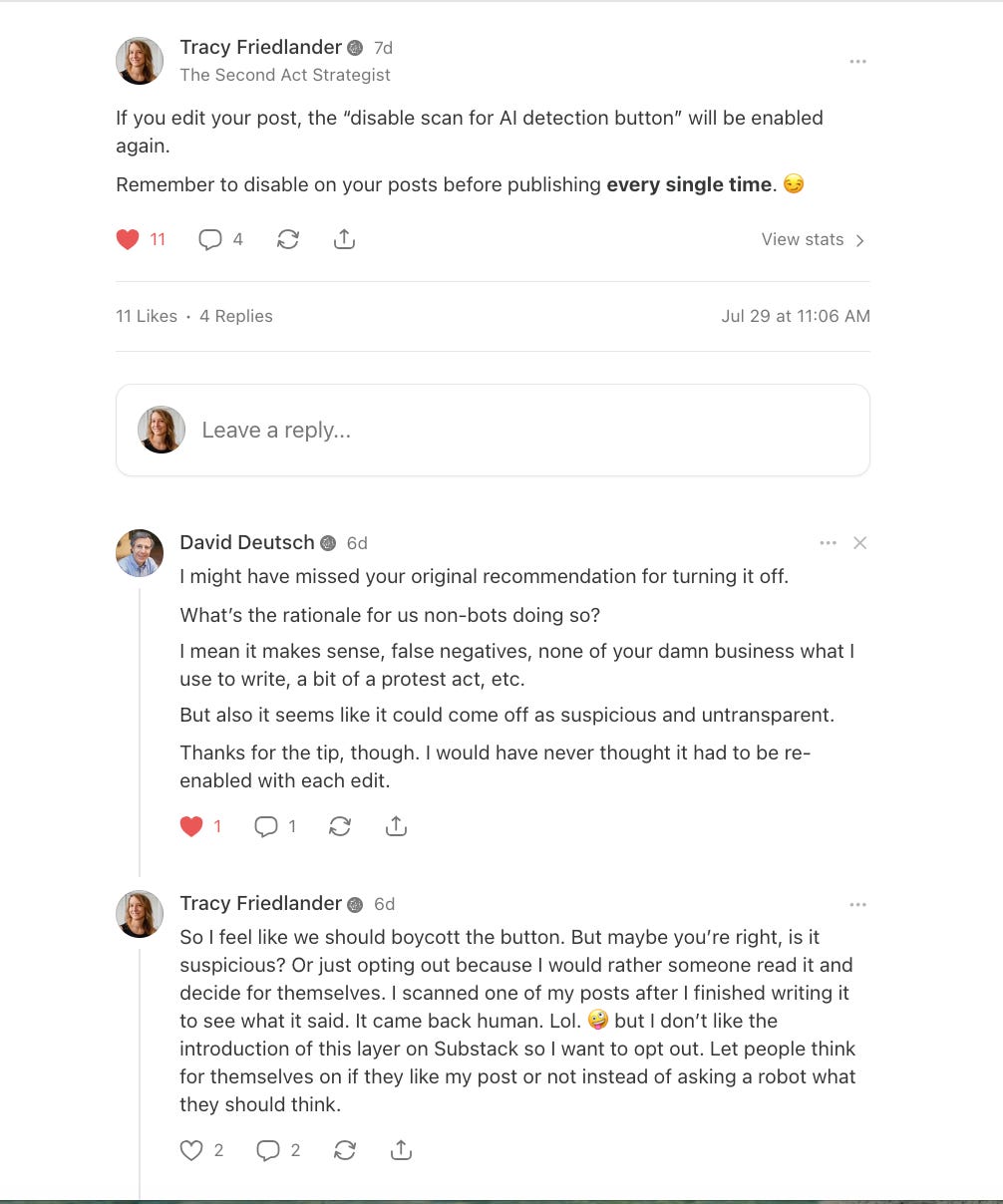
Thank you for David Deutsch for joining the convo on this post!
So — should we disable it? Is it “suspicious” to turn it off? Do we want people to see we’re human when we actually are writing without AI? Or what if we get AI detected when we really didn’t use it? After all, AI was fucking trained on human writing, wasn’t it??
So I feel like it’s complicated and we have a bit of a conundrum, don’t we?
But I’m not one to be a whiner. I am a DO-ER. I want to solve a problem so I can move on because I don’t have time to play around with stuff that doesn’t matter to my bottom line.
In that energy space, the rest of this post is about what to do about it.
I’m taking the following actions so I personally feel more in control and less at the effect of these platforms, that — in all honestly — I’m using/borrowing. They’re not mine. I didn’t create Substack (or Instagram or Facebook or any other of these platforms.)
How do I continue writing, building my own online presence, showing up and creating the dream life and dream business I know I can have, BECAUSE of the internet.
Here’s my list… feel free to borrow any of these ideas!
Take Back My Power Thing #1: I’m not fucking with The Button.
Scan me if you want. Don’t scan me. Fuck if I care. If you want to waste your time on Substack as a little AI police person, go to town.
As a creator who isn’t using AI now to write my long form posts, I am telling you right here: it’s human created. If you don’t believe me, you’re probably not my people. So you can scan away if you want, making the tech bros money while you do it. If you try to come at me in the comments, the button I’m not boycotting is the BLOCK button. 😂
I’m saying it here and now, this post is written without AI. You don’t need to press the button and donate to Tech Bro #987 whoever he is (too lazy to go google his name, ok?)
Take Back My Power Thing #2: I’m using Substack LIVE more
You can’t scan me for AI if I’m just talking. Anyway, it’s a great way to connect and get to know me by seeing me on video.
Take Back My Power Thing #3: Podcasting on Substack
I was a podcaster for 6+ years. That was my first content-creation mode (alongside writing) and where I started in 2016. Podcasting has changed a lot since then.
Huge podcasts backed by huge $$$ changed the game for a while, and that made it seem like podcasting was dead. It seemed like if you didn’t have a fancy in-person studio and NPR money, there was no point in doing it.
But now, podcasting has never been easier, using Substack. You can intentionally create just for people who are opting-in to your world (without feeling like you have to compete on Apple Podcasts or Spotify for listens.)
It’s more intentional. Substack makes it easy.
Not only am I going to be doing that, I’ll be talking about it a lot more.
Audio connects. It helps you get to know people more.
So — how do you “fight” AI slop?
Just by showing up as your real self with your real voice. No button can take that away from you.
Take Back My Power Thing #4: I’m NOT going “all-in” on one platform
If you’ve caught any of my recent lives with Sue B. , you’ll know that this Pangram thing showed me — I should say reminded me — that the big platforms aren’t here for you. They’re playing a different game and it doesn’t have anything to do with you or what you care about.
So what can you do about it? Use each platform for its BEST features (like DMs on Instagram, they blow the Substack DMs out of the water). Do your work. Use multiple platforms so if one of them makes a change you really don’t like you are already connected on another one.
For me — that’s IG, because I previously grew a following there. I use it all the time as a user. I’m going to start creating there again. I will likely add YouTube to that mix since Substack so effortlessly connects to it.
Bottom line? I’m not married to one platform. You shouldn’t be, either.
(And if you have used IG before and are thinking the same as I am? You won’t want to miss my collaborative masterclass about using Substack and Instagram together with Sue B., on Tuesday, August 18th at 1:00 pm EDT/10:00 am PDT. PAID subscribers of either one of our publications gets a free ticket for this event!)
Take Back My Power Thing #5: I’m learning AI for a whole different thing
The truth is, personally, I’m a creator. I am a trained musician and I infuse creativity in my writing that I don’t want to outsource to AI. That’s not to say I haven’t used it in the past for various steps in the writing process, but over time and as the world changes, I’m seeing that messy, REAL writing and creating is standing out as the human thing that people are craving and will continue to crave as more enshittification seeps into our lives.
I saw this post on IG yesterday and I really resonated with what she said. AI is good for coding. No one cares if something was created that way. No one is checking if an app or a platform or a website was created with it. Because it’s the stuff humans can’t do any differently or any faster or better. What a perfect use of AI.
And that’s the reason I’m already working on some new projects I’ll be able to announce soon that have zero to do with AI writing. Using AI to create something that helps us do our creative work more freely is what I’m interested in.
One of the people I love the most who talks about this regularly is Kim Doyal . If you’re not subscribed, RUN (don’t walk!) to read her stuff.
Mia Kiraki 🎭 also talks about AI in a way that keeps it real, which I love. If you’re new to the AI convo, these two are the best ones to follow.
It’s time to rise above the normie conversation people are having around if AI writing is ok or good or bad or worthy of policing or exposing. YAWN! I’m bored.
I know if something is good or not. I don’t need the AI button to tell me if I should read something. I already know in a few sentences. 🤷♀️
So what I’m doing instead? Ignoring that BS and moving on.
Going forward, you’ll see the button on my post. I’m going to save 20 seconds each time I publish by not fishing around in settings to disable it.
So now I ask you — what are you going to do, in an empowered way to stay the course, not get sucked into some BS online, and keep doing the thing you came here to do?
Share with me in the comments, I really want to know! ❤️
I remember that note on AI! And I was like 💯 I went through a similar evolution. At first I was excited. Now I’m just 🙄 over its distilled, boring, generic robot- generated, spit-out.
I’ve decided I don’t care anymore about The Button. Well, I CARE… but for my own writing, if someone uses it and wants to believe a dumb robot’s assessment then, Let Them.
I know I write my own work and don’t need the AI to do it. Sometimes my writing is awesome, and sometimes it lands flat. But it’s mine!
Tracy, “I’m not married to one platform” carries a consequence well beyond distribution strategy. The detector debate shows how quickly a platform can introduce a new layer of judgment around authorship while creators still have to decide what role AI plays in their process, how they disclose it, and how much authority any platform signal deserves. Your return to taste, voice, live conversation, audio, and multiple channels makes authorship something readers can encounter across a body of work, leaving any single detection score in its proper place. Grateful for the way you move this conversation toward creator agency, provenance, and ownership of the relationship with an audience.